
God as the Eternal "No" - Illness, Disease and Catastrophe in The Ages of the World
Posted by | Chris | 2.1.13 | 4 Comments
if the Godhead assumed Being and actively revealed itself through Being (which we must discern as actually having happened), then the decision for that could only come from the highest freedom. (WA: 74)
God is, in accordance with its nature, a consequently, necessarily self-revelatory being (WA: 79)
- God has a nature – it has a ground from which it acts.
- God is self-revelatory – the becoming of God reveals itself to itself.
- This self-revelation is consequent – upon the original cision of the Godhead and the ground which God gives itself.
- Self-revelation is consequently necessary – the force which draws Being to itself is a necessary ground of Beings revelation.
In accord with its ground, therefore, nature comes out of what is blind, dark and unspeakable in God. Nature is the first, the beginning of what is necessary in God. The attracting force, the mother and receptacle (WA: 21)
God himself moved only in accordance with his nature and not in accordance with his heart or in accordance with love (Philosophical Investigations into the Essence of Human Freedom (subsequently FS): 55-6)
the unruly lies ever in the depths as though it might break through, and order and form nowhere appear to have been original, but it seems as though what had initially been unruly had been brought to order. This is the incomprehensible basis of reality in things, the irreducible remainder which cannot be resolved into reason but always remains in the depths (FS: 34)

Grant on eliminativism
Posted by | Chris | 24.9.11 | 1 Comment
In many ways, Schelling’s naturalistic realism offers a counterpoint to the eliminativist strategy in contemporary neurophilosophy: if ideation is electrochemistry, electrochemistry grounds, rather than undermines, all ideation. Therefore, to eliminate one ideation (that has its electrochemical grounds) in favour of another cannot be grounded in physics. (Philosophies of Nature After Schelling: 188)
[continued from the above in a footnote] This is because the metaphysics of eliminativism are complex, involving an epochal or futuralizing Nietzscheanism and a radically synthetic theory of constitutive identity construction: neurolinguistic identities do not simply represent the fruit of epistemological and empirical researches, but trigger a gestalt-shift and reinvent the world. Folk psychology is condemned therefore for its lack of physicalist imagination, rather than any missing physical grounds – what philosopher could disagree? (Ibid: 197)
Is it possible that there is a realism which is in some sense eliminativist? Because if so, then there are all sorts of ontological problems with that. If not, then, if nothing can be eliminated, then we have a situation where it no longer makes sense to ask, ‘What is the difference between a hobbit and a quark?’, or for that matter, between Rorty and Husserl! Actually, is there one? Or rather what are the differences? There are several differences between these entities, but to use a difference as a disqualification for their being ‘real’ or not is simply to beg the question about realism, fundamentally. And for that reason, it seems to me that a non-eliminative realism is committed to becoming a form of idealism, in which case we merely extend realism to the Ideas: In which case we no longer have the problem of the separativity, the subtraction, of ideation from nature, which you were suggesting might be a problem. (Collapse 3: 321)
So, for example, this is the method of eliminativism: I’m investigating an object, call it a car, and this car, it is alleged, drives by itself. Now my job is to explain how it is that the car drives, and at the end of the explanation it should be clear. The false explanations have been gotten rid of and a good explanation put in their place. So, let’s say all those criteria have been satisfied, let’s say that is achieved. What has the theory achieved at the epistemic level? It’s managed to produce exactly that explanation. What’s achieved ontologically? It’s managed to commit itself to an ontology which requires that things that do not exist exist in order that they be eliminated. So it’s ontologically inconsistent but epistemologically necessary. I can see its virtue, or I can see its requirement epistemologically. But the question must be put, I think, the other way around: If we work out what the ontology demands, then that provides a means of working out answers to the differences between good and bad explanations, whatever they might be. My suspicion is that otherwise we find ourselves backed into an unsustainable metaphysics of not-being. (Ibid:365)
Hot off the virtual press.
Posted by | Chris | 18.6.11 | No Comments
Essays by Paul Ennis, Graham Harman and others (plus the sound of your brain) in Continent:
http://www.continentcontinent.cc/index.php/continent/issue/current
The first issue of the long awaited Thinking Nature:
http://thinkingnaturejournal.com/volume-1/
Idealism: The History of a Philosophy - Review
Posted by | Chris | 20.5.11 | 6 Comments

Idealism: The History of a Philosophy achieves its subtitle with admirable and compelling clarity, weaving an intellectually invigorating narrative of two and a half millennia of idealist thought. An area of philosophy much maligned, and, in the estimation of the authors, much misunderstood, the book sets out to rediscover the potential of the Idea by explicating the common themes and problematics of its thinkers and to counter criticisms by showing the powerful conceptual possibilities and contemporary relevance of idealism.
Divided first into sections (ancient, early modern, German, British and contemporary idealisms) and then into chapters, each focuses on a thinker or group of thinkers representative of a certain branch of idealism. The great strength of these chapters is their condensation of an easy to understand introduction to some of the important features of each philosophers work. History is always partial of course, and Idealism is no exception. The argument made throughout the book is for a continually developing philosophy, bringing the power of the Idea to bear in broad range of topics – including those often considered as antithetical to idealism.
The central claims of the authors, repeated and rehearsed in arguments throughout the book, are:
- Philosophical idealism need not exclude either naturalism or realism, nor is it necessarily anti-science.
- Idealism is instead an extreme or cosmic realism, a realism about all that there is.
- In particular it is realism concerning the Idea: the cause of an organisation that is not formal, abstract or separable “but rather concretely relates part to whole as whole [...] such an idealism is a one-world idealism that must, accordingly, take nature seriously” (8)
The book begins as it means to continue: by challenging the casting of idealism as an early modern phenomena that makes reality entirely mind dependent. The first idealism, it is argued, comes from Fragment B3 of On Nature, the Parmenidean identity thesis: “it is the same thing that can be thought and that can be” (Cornford 1939: 34) (alternatively: “thinking and being are the same” (Philips 1955: 553)). This is an ancient idealism that is explicitly metaphysical and cosmological in scope. The book sets a pattern for what is to follow: by engaging with primary works, pointing attention to translation, interpretation and reception, and critically examining these in the context of a consistent case for idealism as a philosophy of pressing relevance in contemporary discussions.
Parmenides' philosophy is taken as the starting point for Plato's work, presented here as a one-world metaphysics of the dynamics of the Idea. Plato grapples with the problems of monism and questions of being, becoming and non-being. His dynamics are here described in terms of attractors – immanent powers combining efficient and final causality – through which nature becomes what it is. The Neoplatonists develop this physics of the Idea and continue to question the role of causality, the problems of the production and differentiation of nature and the place of reason in the world. Platonic physics sets the standard for all subsequent idealisms, and its focus on natural production and cosmology mark them as truly global in their purview. The chapter makes a clear and well-structured argument for a one world Platonic physics, a view that is perhaps not widely accepted but on which attention is beginning to focus. Indeed, the argument here is considerably clearer than it is in Grant's Philosophies of Nature After Schelling. This comparison makes clear the consistent clarity of writing in Idealism and it's potential audience which could include interested under-grads, the curious uninitiated and also those more experienced philosophers who are perhaps no less unfamiliar with idealism as it is presented here.
Descartes and Malebranche are taken as having as given clear articulation to the problems of Idealist dynamics when they are limited to a certain segment of reality. In particular this early modern philosophy is a response to materialist science in a retreat to phenomenalist idealism. In contrast to Plato's global metaphysics, idealism here begins its retreat to the minds of individual philosophers to escape the problems of science and nature. This circumscription of the domain of the powers of Ideas is a consistent theme of the book - running into 20th century neo-Hegelenianism - and a sticking point for criticism of insufficiently global philosophy that refuses the 'extreme realism' the authors argue is the greatest legacy of idealism.
The tension of philosophy and science also introduces another point of insistence for the authors. If much of 20th century continental philosophy has displayed an illiteracy, or worse, disdain, of science that has left it unable to face up to the problems and developments of the 21st century, this does not mean that a newly engaged, naturalistic and speculative philosophy cannot make productive use of the conceptual legacy of idealism. If idealism is extreme realism the one thing it is surely opposed to is reductionism, especially mechanical materialism. To admit “a real distinction between matter and spirit leads ultimately to an insoluble problem regarding causality. If mechanist matter is inert and lifeless then how can it cause consciousness?” (204). If the phenomenalist or subjectivist idealists err by retreating into a world of sensation it is not a failure of imagination but the problem of causation. The dynamics of the Idea provide the motor of becoming, but is there any reason why this dynamism need be limited to consciousness? Properly oriented idealist naturalism is possible and there is no reason, as Galen Strawson has argued, why idealism might not also be a form of materialism (quoted 12).
Interestingly Berkely is one of the stars of the book. Often considered paradigmatic of subjectivist idealism, this conception is complicated and set in context. Whilst clearly the most extreme of the phenomenalist idealists the problem of solipsism, the common functioning of minds and the eternal existence of Ideas as the ground of the temporal are all addressed by Berkeley. His philosophy takes a small section of the book, but critics of idealism who suggest that “idealism = Berkeleyanism” are referred to the scope and urgency of idealist thinking, which Berkeley himself manifested, and which this equation ignores.
The German idealists occupy the middle section of the book and this period of sustained development of idealist thinking is exhilarating to behold. Each chapter could serve as an introduction to the specific philosopher, but the focus of the book also draws out elements of their thought in relation to the eternal and the temporal, the structuring role of Ideas, and the dynamics of thought and nature. The final chapter of this section on Hegel is a high point of the book, rightly proclaiming Hegel as one of the most accomplished thinkers of the Idea – expanding and developing idealism through his concept of the 'concrete universal'.
The chapter on Hegel especially (but also Kant and Fichte) serves to highlight one of the potential criticisms of the book however – namely that criticism of the idealists themselves is minimal. The philosophy of every thinker included here is presented as part of an argument for a continuing problematic of idealism and as such the positive aspects of their work are foregrounded. The failures, blind-spots and omissions are only hinted at or addressed briefly. For example “Hegel’s stupefying judgement in the Encyclopaedia (§ 339) that there is nothing philosophically pertinent in geology” (The Speculative Turn: 41), obviously recognised by Grant, is not raised here. The reason for this generous dispensation is obvious however: there is ample literature devoted to criticisms of idealism, so much so that in the opinion of Dunham, Grant and Watson that these criticisms have become caricatures. The purpose of Idealism is to redress the balance and to make a case by careful engagement with these thinkers on their own terms, to unearth the concepts which animate their thought and to make their legacy a viable and fertile are for future investigation. The book does highlight problems with its protagonists, especially in later chapters, but these are set in the context of a philosophy which can provides the resources for engaging and overcoming these problems rather than simply dismissing them - either as unproblematic or uninteresting.
The penultimate section of the book takes a look British idealism from the early twentieth century. This is a fascinating section showing the development of German idealism (especially Hegel) in a different context, and, most interestingly, surveying the historical roots of the analytic-continental divide. It is a point to remark upon that G.E. Moore's Refutation of Idealism (1903), and the post-idealist generations of philosophers, for example Russell and Frege, are imbued with overt an Platonism. In this way Idealism also weaves its argument, putting forward Hegel as a presence in philosophy whose impact has not yet been fully understood, and whose development of the Idea holds the seeds of changing attitudes and approaches to the old divisions.
Two brief surveys of idealist science are over all too quickly before the final chapter on contemporary idealisms. The scientists chosen for this idealist experiment are Maturana & Varela and Stewart Kaufman. The case for Maturana & Varela's idealism is intriguing since it is made against their own arguments, revealing a tension in their work between idealist realism (organisation, autopoesis, Idea), Kantian critical impulses (disavowing organisation as a fact of nature), and a commitment to mechanical materialism. That idealist science is here biological science will do little to quiet critics of vitalism, though quick reference to Lee Smolin and Julian Barbour, whose fields of physics and cosmology could not be more wide ranging, show the potential of idealism in science. The chapter ends with a quote from Smolin, in what could easily be a call to action: “In the past, philosophers like Leibniz did not hesitate to tell physicists when they were speaking nonsense. Why now, when so much is at stake, are the philosophers so polite?” (Smolin 1999: 244; quoted 255).
There is more packed into the books 300 pages than this review can do justice to and the shear number of interesting avenues of thought opened here is a testament to the authors achievements. Deserving more than this brief mention other highlights include the survey of neo-Hegelians, including Žižek, which is critical of the insufficiency of metaphysics sublimated to ethical axiology. Also, the section on Whitehead, especially in contrast with a potentially even more exciting and much too brief look at Deleuze, whose presentation as an idealist is wonderfully heterodox. These thinkers and there reading here have much to add to recent debates, including that between Grant and Harman (The Speculative Turn: 21-46). Idealism is a work of impressive study and a stimulating project that, whatever your position, will be a cause for new thinking and a challenge to our ideas.
Thirst for Annihilation
Posted by | Chris | 4.4.11 | 1 Comment
Particles decay, molecules disintegrate, cells die, organisms perish, species become extinct, planets are destroyed and stars burn-out, galaxies explode…until the unfathomable thirst of the entire universe collapses into darkness and ruin. Death, glorious and harsh, sprawls vast beyond all suns, sheltered by the sharp flickerlip of flame and silence, cold mother of all gods, hers is the deep surrender. If we are to resent nothing—not even nothing—it is necessary that all resistance to death cease. We are made sick by our avidity to survive, and in our sickness is the thread that leads back and nowhere, because we belong to the end of the universe. The convulsion of dying stars is our syphilitic inheritance. (146)In Mark Fisher's talk at the Accelerationism conference last year he says that Nick Land “took seriously to the level of psychosis and auto-induced schizophrenia – and that's really true – the Spinozist-Nietzaschean-Marxist injunction that a theory cannot be serious if it remains at the level of representation”. Thirst for Annihilation: George Bataille and Virulent Nihilism is not then a work of academic study but a practise, or an attempt at one, a working with Bataille in an exacerbation aimed at collapse of the strictures of the academy, religion, philosophy and ultimately humanity.
Land's work with Bataille is something like an experimental physics of expenditure. Bataille's solar economy ungrounds thought by recognising all power as given antecedently by a greater power. This economy is not one of increasing returns or teleological aims however, but a meaningless waste of energy, consistent and purposeless expenditure. Living creatures and all societies are marginal detours in a return to nothing, or death.
Death is perhaps the central concept of the book and I find it difficult to fully articulate all of the ways in which Land deploys it. For one thing at least, death is not the phenomenological horizon of anything's being, nor is it simply the entropic slide to disorganisation. Death is the negative force at the heart of Land's ontology, the aggressive exchange of power to the sum of zero.
Among the motors of Land's book is his septic hatred for all hierarchy, all territorialism. Land's sworn enemy is God, the emblem of all conservative authoritarian accumulation. Land argues quite interestingly for atheism understood in a positive sense; it indexes not a reaction against-God, but a productive real without God. What sometimes undermines this argument, and occasionally tried my patience, is Land's obsessive return to the subject of theism, seemingly incapable of getting more than a few paragraphs without hurling some new insult. This insistent hatred doesn't only weaken arguments about atheism however, but points to a larger problem within the book as a whole.
After God, Land's most despised enemy is Kant, and the sections dealing with his legacy are among the most interesting of the book. Land's position as a founding influence among speculative realism is clear from many passages and his diagnosis of the withered and introverted state of post-Kantian philosophy exhilarating to behold, accomplished as it is with the nauseating gusto of Land's writing.
Land's remedy to Kant's division of the world according to epistemology is an ontology of primary production from which thought as secondary production arises. Base materialism as put forward by Bataille considers all matter as libidinally powered and productive. Base matter produces thought and instantiates a second order of production with a tendency to transcendentalise itself, to take credit for all action in the world and demote base matter to inert resistance. A libidinal materialism however recognises the power of base matter and is able to make contact with in certain intensifying actions: sex, violence, visceral and bodily connections unmediated by thought.
Land's Bataillean subversion of the Kantian schema owes much to Deleuze and Nietzsche with intensive powers providing the motor for non-teleological becoming. The problem that I see in Land's project owes to an imbalance or one-sidedness of concept. What does death destroy, what does action intensify, if not the conservative forces of instituted order? But what institutes order?
It seems to me that Land is obsessed with God because he needs Him; without a territorialising force there would be nothing to deterritorialise. Of organising creativity Land has almost nothing to say, except for a brief section on negentropy where diversion from expenditure is ruled “not impossible”. Chance deviation is basis of all instituted structure yet this seems exceptionally poorly matched to the all consuming power of death, or zero, as the eternal motor of destructive exchange. A political or theological dualism between massive ordered hierarchy and atomised co-operative anarchy is ontologised with the greater share of power going to all deterritorialising forces, leaving accumulative forces under-explained except for the dictatorial myth of God and society.
Despite it's flaws and it's occasionally self-indulgent prose Land's book is an exceptional work, and exhilarating ride through an axis of philosophy rarely explored with such bilious fury. At it's highlights, especially those sections where Land undermines Kant with dark sarcasm and a carefully chosen quote from one of the critiques, it's philosophy at it's most exciting. Like Nietzscheanism it's difficult to imagine anyone living like this, and Land it seems wasn't able to keep up the relentless pace, but as inspiration for all deviant intellectuals it is unparalleled.
In the Aftermath of German Idealism
Posted by | Chris | 16.3.11 | 1 Comment
In the Aftermath of German Idealism
May 14-15, Käte Hamburger Kolleg "Recht als Kultur", Bonn,
in cooperation with the Bergische Universität Wuppertal
Keynote speakers:
Markus Gabriel, Universität Bonn, author of Der Mensch im Mythos and Transcendental Ontology (forthcoming by Continuum)
Jean-Christophe Goddard, Université de Toulouse le Mirail, author of La philosophie fichtéenne de la vie
Arnaud François, Université de Toulouse le Mirail, author of Bergson, Schopenhauer, Nietzsche. Volonté et réalité
Sean McGrath, Memorial University of Newfoundland, author of The Dark Ground of Spirit: Schelling and the Unconscious (forthcoming by Routledge)
Devin Zane Shaw, University of Ottawa, author of Freedom and Nature in Schelling's Philosophy of Art
It is with pleasure we invite you to participate at the following conference, sponsored by EuroPhilosophie (www.europhilosophie.eu) and organized by l'Amicale des étudiants EuroPhilosophie.
Since the philosophical upheaval caused by Kant's transcendental philosophy, the status of what would later be called “German Idealism” has been anything but clear. On the one hand, the efforts of the major representatives of post-Kantianism only intensified the intrinsic ambiguity of the founding gesture of the tradition. Instead of simply interpreting or expanding Kant, yet all the while attempting to radicalize his original breakthrough, Fichte, Schelling and Hegel developed surprisingly different and opposing systems. On the other hand, the 19th- and 20th-century reception of Hegelianism would have another decisive effect, which would in its own way obfuscate the signification of German Idealism by drastically altering our perception of the tradition as a whole. Not only was Hegel thought to be the culmination of the operative logic of German idealism, which would for a long time prevent us from understanding the works of Fichte and Schelling in and of themselves, but there was also a primordial urge to immanently rethink Hegelian dialectics from the standpoint of historical finitude while being faithful to its fundamental insights, arguing for the implicit and irreducible potential still lurking in this movement.
However, the history of German idealism did not in any way end there. In the 20th century we have seen seen a countless number of virulent attacks against “traditional” metaphysics arise as different philosophical schools demanded us to give up “dead” and “outdated” notions like system and totality, German Idealism often being seen the as the epitome of excessive, unbridled reason. Yet, in the face of these so-called “devastating” critiques, classical German philosophy has not been sentenced to death and banished to the abyssal forgetfulness of a forever lost past. Not only has there been an intense increase of secondary literature in the past decades, but a multitude of contemporary philosophers are returning to this moment in order to develop their own thought. The status of German Idealism remains more ambiguous and uncertain than ever: even two centuries after its emergence, we are still in the wake of German Idealism and feel its effects deep within the internal pulsations of philosophy itself.
Therefore, the goal of this conference is to open up an space within which one approach the reception of German Idealism and address its philosophical heritage. The unifying theme will be the following constellation of questions: Why do we constantly go back to German Idealism and cannot simply rid ourselves one and for all of its fundamental concepts? What could German Idealism teach us today? Are there still non-cultivated resources lurking within the thought of Kant, Fichte, Hegel and Schelling? Are we only able to unearth these resources today by passing through their internal and external critiques? Should we take the risk and plunge headfirst into the tradition in attempting to radicalize it?
Please send a short abstract (200-400 words) for a 20-30 minute presentation to be given in English, French or German to Joseph Carew (jstephencarew[at]gmail.com) and Daniel Pucciarelli (arelli[at]gmail.com) by the 6th of April.
Proposed topics are (but in no way limited to)
- The immediate reception of German Idealism (Jacobi, Reinhold, Schulze, Maïmon, Marx, the Schellingian, Feuerbachian, Kierkegaardian, Schopenhauerian or Marxist critique of Hegel)
- The tole of concepts such as “finitude,” “system,” “totality,” “liberty” or “subjectivity” in German Idealism and its reception
- The category of contingence in Schellingian and Hegelian dialectics
- Contemporary rereadings of Hegel (Frankfurt School, Butler, Jameson, Malabou, Nancy, Pippin, Žižek)
- The current resurgence of Schelling (Grant, Gabriel)
- The appropriation of Hegel by representatives of analytical philosophy searching for a new grounding for epistemology (McDowell and Brandom)
- Critique of the notion of history and post-Hegelian philosophies of history
- Contemporary usage of German Idealism in practical philosophy
- Critiques of German Idealism from within different philosophical movements (phenomenology, Heidegger, Derrida, Foucault, Deleuze – and so on unto infinity)
- New interpretations of Kant, Fichte, Schelling and Hegel
Ray Brassier doesn't like you.
Posted by | Chris | 5.3.11 | 15 Comments
The ‘speculative realist movement’ exists only in the imaginations of a group of bloggers promoting an agenda for which I have no sympathy whatsoever: actor-network theory spiced with pan-psychist metaphysics and morsels of process philosophy. I don’t believe the internet is an appropriate medium for serious philosophical debate; nor do I believe it is acceptable to try to concoct a philosophical movement online by using blogs to exploit the misguided enthusiasm of impressionable graduate students. I agree with Deleuze’s remark that ultimately the most basic task of philosophy is to impede stupidity, so I see little philosophical merit in a ‘movement’ whose most signal achievement thus far is to have generated an online orgy of stupidity.I'm aware that my post below, a jumbled collection of my feelings after finishing Nihil Unbound, didn't amount to much in the way of philosophical contribution. It's not much of an argument to think that someone's a bit mean. Reading the paragraph above however, I was struck again by just how ruthlessly unpleasant Brassier can be. To say that he lacks the urbanity of thought which Whitehead praises in Plato for instance would be an understatement.
Clearly, to show disdain for those philosophers with whom you disagree does not disqualify your own thought. In fact, Brassier is that much more imposing because he clearly wields a formidable intellect, intervening with technical acumen across a wide spectrum of philosophy.
The remorseless attacks on opponents clearly stem from Brassier's nihilist will to know (truth). A program of knowledge so mono-maniacally motivated by objective truth will clearly regard other disciplines and ideas as false, pointless distractions. I am nervous of attempting to mount a counterargument to this attitude and the possibility of sounding like a relativist, thereby consigning myself to the same anti-philosophical trash-heap as so many of Brassier's foils. However, such a challenge can be made, most interestingly on the grounds of what defines philosophy and science.
Brassier describes the relationship of philosophy to science as being to distinguish "which of its metaphysical assumptions are empirically fertile, and which are obstructive and redundant". I would tend to agree with this. But my problem with Brassier's project is the very narrow characterisation of these disciplines. Very briefly, I think that it is difficult to countenance a philosophical program which is so concerned to pitilessly policing the discipline and ejecting from it all but those select few who conform to your way of thinking. To say this is not to admit relativism or anti-realism, only to suggest that in the continuing adventure of intellectual discovery there are many things of which we cannot be certain, and therefore it would be better to nurture a pluralistic, respectful and open attitude at the same time as engaging in constructive dialogue about truth, knowledge and the world. There may be many more 'empirically fertile' a priori assumptions than Brassier would like to admit.
Public Domain Plato with Stephanus Pagination.
Posted by | Chris | 1.3.11 | 6 Comments

Prompted by this I have collected two English translations of Plato's Timaeus and the original Greek. I have used Benjamin Jowett's 1871 translation available from Project Gutenberg, W.R.M. Lamb's 1925 translation available from Perseus and the Greek also from Perseus.
I'm aware that Jowett's translation is not highly regarded. I can't find any comment on Lamb's. However, both are available for free and side by side with the Greek they at least give a place to start in a study of the Timaeus.
The document is available to download as a PDF here. This is a first edit for which I have not fully checked. A properly corrected version will follow.
Completely at odds with reality
Posted by | Chris | 22.2.11 | 1 Comment
I don't know if it was Cameron or the Guardian journalist who describes Gulf nations as though they were fluffy woodland creatures: "[it's] wrong to leave small Gulf countries to fend for themselves".
It's also darkly amusing to note that Cameron invokes Iraq's invasion of Kuwait to justify the arms trade. Who armed Iraq then?
His "staunch" three-point defence appears to amount to:
- People should be allowed to defend themselves (read "militarily supported dictators" for people).
- We're not as bad as other countries.
- We do some nice things as well as selling bullets to repressive regimes.
The differentiated powers of lumpy productive substance
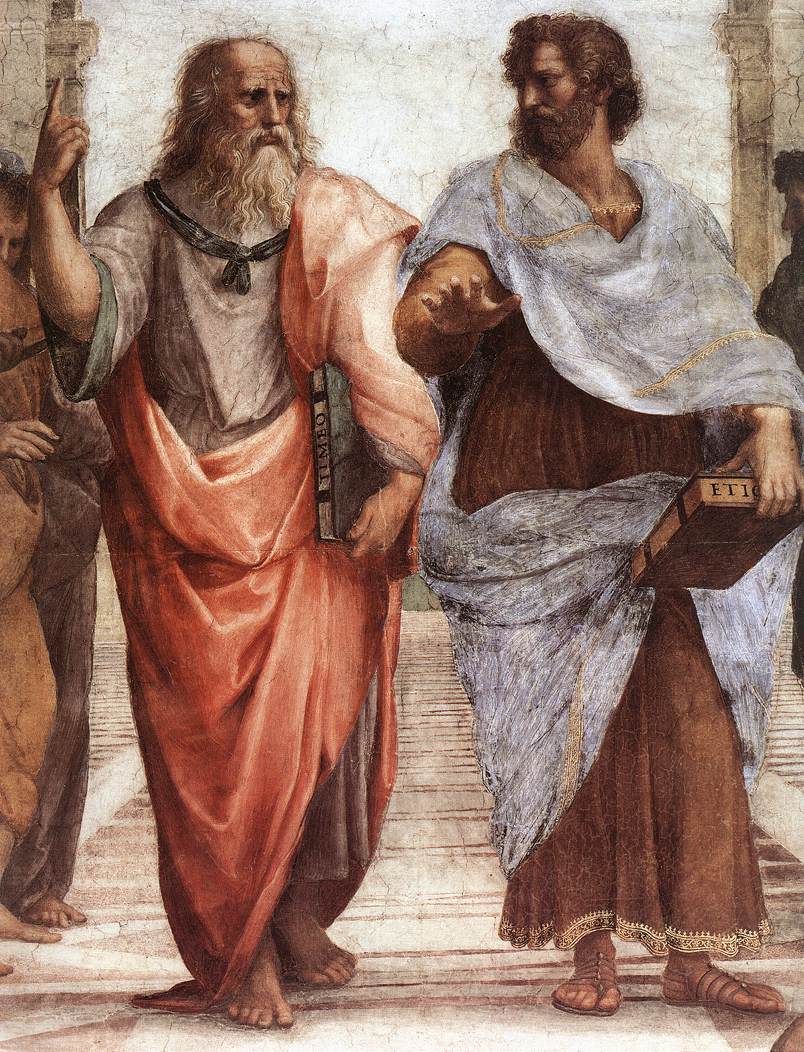
For me this is the most exciting debate to come out of The Speculative Turn, highlighting the differences and marking terrain not just between OOO and "Grantian-Schellingian powers" (for want of a better designation) but at the heart of metaphysics. This question runs right back to Plato and Aristotle: what is primary, substance or power?
Bryant himself pointed out the lineage of this discussion just a few days ago. However, and I think representatives of OOO would agree, it is too simplistic to mark alliances in terms of Aristotle-OOO/Plato-powers. While these alliances are extant, in both cases a process of appropriation, argumentation and transformation is underway. Here, I wish to make two brief points: 1) I disagree with Aristotle'/Levi's reading of Plato; and 2) there is a problem of powers predicated of substances which the productive substances of OOO occlude rather than solve.
First, the Platonic forms are not reified predicates. There is no beauty itself, since new beautiful things are always possible and the complete history of beauty is unrecoverable. The failure of Socrates and his interlocutors to adequately define any of the ideas attests to their non-objectifiable nature. I argue instead for a powers ontology reading of Platonic physics, although this is a point for extended discussion.
Second, the gambit of OOO, that being is plural and substantial, is an attempt to do justice to our experience of mid-size objects and to avoid an ontology of pre-individual apeiron. Plurality is unproblematic, but the substantial element of OOO is tied to a problem of anteriority -the answers to which seem to dissolve the difference between powers and substances.
OOO argues for the creation and destruction of substance and so any necessary ontological substance - a primary substance as uncreated pre-requisite of all being - is ruled out. With productive substances there is a regress of "objects all the way down". I agree with OOO that this is an unproblematic regress, akin to contemporary debates around ungrounded powers.
In powers ontologies their is often an equivocation regarding powers and substances: powers are ungrounded, yet they are also dispositional and predicated of things; i.e. held by something, therefore not ungrounded but grounded in substance. This is the problem of anteriority: if powers are held by substances then from where did the substances come? If substance is a product of powers then either these powers must also be held by substance - and this regress is problematic - or powers are not predicated of substance and are properly ungrounded.
It seems to me that the argument for productive substances of OOO avoids this problem by blurring the definition of substance and power. If "substances are produced out of other substances" and "anteriority is not something other than substances, but rather is composed of other substances" how is substance different from power? The answer to this question is made quite plain by Morton: "production is a substance"; i.e. they're not different except that the production of OOO is 'chunky' or 'lumpy'.
As Bryant observes then, it seems that there is in fact little dispute between ontologies of substance and those of productive powers. But, I feel that this reply leaves too much unexplained. In marking the difference between power and substance we are also returned to another dispute: the relational vs. non-relational. This is a challenge to powers ontologies to which no reply has yet been properly articulated.
Regarding any apeiron of powers, the avoidance of which the lumpy productive of OOO is aimed at, Shaviro puts the point well: "The "pre-individual" (in Simondon, Deleuze, Grant) is NOT continuous, not the whole, not undifferentiated. Rather, it's the realm of powers."
Is there a difference between power and substance? I don't think that they can easily be collapsed and therefore this dispute goes on.
The death of the stars means I don't have to listen to you.
Posted by | Chris | 20.2.11 | 3 Comments

Hello world! I have the internet at home again so I'm back in the matrix. I've been in one of those moods recently where I'd read a bit and feel like I should read some more before I wrote anything; the writing is eternally deferred and my reading amounts to little more than "oh, that's interesting". I've not been very productive.
During this period I've reread Nihil Unbound and searched out a few essays by Brassier and his influences. I find equal parts of Brassier's philosophy exciting and repellent. His commitment to realism, his insightful critique of other philosophers, his engagement with science are all things to admire and learn from. What I find I cannot endorse however is a certain tone of writing, the stylistic match to his project of 'disenchantment'.
Clearly my distaste at a certain type of prose is not in any way a philosophical rejoinder to the project of disenchantment. Were I to present it as such I have no doubt that any lucid nihilist-scientist would destroy my position with ease, or more likely simply disregard it.
Many of Brassier's arguments are serious, sometimes savage, challenges to his opponents. But none of them destroy or eliminate their target. If you are committed to phenomenology then it is likely that you will simply ignore Brassier's arguments.
Brassier may be right about the meaninglessness of existence, the unilateral power of being and its "being nothing". In the nihilist atopian future we may all join in making ourselves equal to the nothing of being, joining in the will to know. But this somewhat facetious prediction contains the kernel of one of my central criticisms; Brassier, like his eliminativist allies, appears quite concerned to tell other people how things should be done and spends much of his time adding to the list of things which we should disregard as a meaningless waste of time. What remains appears to me to be a mean-spirited essentialism about knowledge and science.
None of this amounts to a proper argument against this type of philosophy. Indeed, I have a hard time disentangling what I agree with from what I would choice to challenge. But one final thing that really makes me feel unwell is the disdain sometimes reserved for other style's of philosophy when in fact a stylistic choice seems to inform some of the work of Brassier's and his counterparts. Brassier is biting about leaving phenomenology as literature, yet much of his own work is effective precisely because of his gloriously nihilist rhetoric.
Again, none of this disqualifies the arguments, but it adds to the impression of a type of philosophy unconcerned to engage its opponents, assured as it is of its own superiority it can simple present the facts and flip you the finger if you disagree.
Timothy Morton's been writing recently on scientism and I especially enjoyed this irreverent post.
which reminds me
Posted by | Anonymous | 30.1.11 | 1 Comment
... a non-trivial number of Atlas Shrugged readers are possibly far enough along the Asperger spectrum that they don’t recognize humanity does not in fact easily suss out into Randian capitalist superheroes on one side and craven socialist losers on the other, or that Rand’s neatly-stacked deck doesn’t mirror the world as it is, or (if one gives it any sort of genuine reflection) model it as it should be.
Libertopia
A heavy smoker who refused to believe that smoking causes cancer brings to mind those today who are equally certain there is no such thing as global warming. Unfortunately, Miss Rand was a fatal victim of lung cancer.
However, it was revealed in the recent "Oral History of Ayn Rand" by Scott McConnell (founder of the media department at the Ayn Rand Institute) that in the end Ayn was a vip-dipper as well. An interview with Evva Pryror, a social worker and consultant to Miss Rand's law firm of Ernst, Cane, Gitlin and Winick verified that on Miss Rand's behalf she secured Rand's Social Security and Medicare payments which Ayn received under the name of Ann O'Connor (husband Frank O'Connor).
As Pryor said, "Doctors cost a lot more money than books earn and she could be totally wiped out" without the aid of these two government programs. Ayn took the bail out even though Ayn "despised government interference and felt that people should and could live independently... She didn't feel that an individual should take help."
Nature and Freedom
Posted by | Anonymous | 16.1.11 | 1 Comment
Since Alex is summarizing the presentations that happened this week, you may as well just read my paper here:
Does the Critique of Judgment Bridge the Gulf between Nature and Freedom? [pdf]
And here is the paper I gave before Christmas, about Fichte and Schelling:
The Contemporary Relevance of Fichte's and Schelling's Philosophy to the Problem of Freedom. [pdf]
comments
Posted by | Anonymous | 4.1.11 | No Comments
As you will observe, there is now a 'Recent Comments' gadgetoid on the right-hand side of the blog.
You can click the post name to read the whole comment.
beauty and virtue
The award for longest book title in the world goes to:
'An Inquiry Into the Origin of Our Ideas of Beauty and Virtue, in Two Treatises, in Which the Principle of the Earl of Shaftsbury Are Explan'd and Defended Against the Author of The Fable of The Bees, and the Ideas of Moral Good and Evil are Establish'd According to the Sentiments of the Ancient Moralists. With An Attempt to Introduce a Mathematical Calculation in Subjects of Morality' by F. Hutcheson (1694-1746).
Universal Acid
Reading the Stengers chapter in The Speculative Turn when I ought to be writing about noumenal causation, I came across this paragraph about eliminativisim and Dennett (et al):
The universal acid of the so-called dangerous idea of Darwin is just what is needed. It brings no effective understanding of evolutionary processes but is eliminating, dissolving away, all reasons to resist the redefinition of humans as a piece of engineering that can be understood in terms of algorithms, and modified at will. And those who struggle against this operative redefinition of our worlds will have against them the authority of reason and science.
The Future Is...
Posted by | Chris | 29.12.10 | 4 Comments
I've got a great deal of respect for Shaviro's Whiteheadianism; Whitehead is perhaps my favourite philosopher and Shaviro's work has done a great deal to present and make clear the relevancy of Whitehead to contemporary debates. I love Shaviro's application of Whitehead to contemporary technological and cultural questions too. However, in the current debate I find I'm more keenly aware of Whitehead's shortcomings than of his sometimes daring, but always urbane, contributions to philosophy.
Graham Harman has often made clear his debt and appreciation to Whitehead, but equally he has been quick to point out the difficulties presented by Whitehead's ontology. Primary amongst these is Whitehead's relationism. For Harman any ontology defined entirely by its relations is unable to account for change. If any entity is defined by it's relations then it is exhaustively defined, there is nothing beyond its relations and hence nothing which might act as a motor for change in the entity.
I find it interesting that while Whitehead's realtionism is the main point of argument in Harman's reply, he makes no mention of 'decision' which holds a central place in Shaviro's Whiteheadian rebuttals to OOO. In Whitehead's philosophy decision is the final act whereby entities become what they are. It is the selection among alternatives which gives each entity its particular view on the world. Recently Shaviro has suggested that some variant of panpsychism might more usefully address problems in the sciences (as opposed to a focus on 'life') by considering mentality incipient in all things. This mentality Shaviro construes in terms of decision.
Perhaps the reason Harman does not address decision is that a criticism of it is implicit in his attack on Whitehead's relationism:
As [Whitehead] puts it early in Process and Reality: ‘The analysis of an actual entity into “prehensions” is that mode of analysis which exhibits the most concrete elements in the nature of actual entities’. In other words, to speak of actual entities in terms of anything but their prehensions is a mere abstraction; the entities themselves are concrescences, or systems of prehensions.(Response to Shaviro: 296).The entities of Whitehead's ontology are nothing but their relations and there is not substance or power left over which could make any decision.
I fear that Harman may be right about this. There are further problems for Shaviro and Whitehead when one considers God's role in every actual entity's decision (the freedom of which is extremely questionable). And yet I'm not willing to concede an absolute victory to Harman in this case. Whitehead's metaphysics may not be riddled with difficulties (or possibly incoherent), but there is more in it than Harman's argument implies.
For one, I reject Whitehead's ontological principle as the measure of his metaphysics. This is contrary to Whitehead's explicit intentions, but it seems to me that Whitehead himself fails to maintain the principle. If the reason for any change is to be found in actual entities then the notion of an actual entity must be expanded to include the eternal objects. This brings me to my second objection: I strongly disagree with Harman's characterisation of 'eternal objects'.
[Whitehead] thinks that qualities pre-exist: he calls them ‘eternal’, after all, and links them with the Platonic forms. No new qualities can ever be produced for Whitehead, for all his reputation as a philosopher of novelty: what is produced in his view is simply new constellations of actual entities, prehended according to pre-existing eternal objects (Ibid: 298).Whitehead certainly deserves some of the blame for this - I wish he'd called his potentials anything but 'eternal' - but Harman's linking them to Platonic forms (in a pejorative sense) needs some explanation. There's little question that Whitehead is a Platonist, but to suggest that his metaphysics conforms to two-worlds ontology of forms is to do a disservice both thinkers.
In Adventures of Ideas Whitehead explicates his metaphysics as a doctrine of immanent law by way of Plato's definition of being as power:
My suggestion would be, that anything which possesses any sort of power to affect another, or to be affected by another even for a moment, however trifling the cause and however slight and momentary the effect, has real existence; and that the definition of being is simply power (Plato, Sophist, 247E).A powers ontology is a long way from the traditional two-worlds ontology traditionally attributed to Plato. To similarly complicate Whitehead's ontology, would be to include eternal objects in the creative generation of the actual entities in the manner promised by Whitehead if not delivered.
To pull Whitehead in this direction is to make him something like a philosopher of the rumbling apeiron of thinkers like Grant (see below) and Harman is clear that he rejects interpreting Whitehead in this way:
You can say what you like about Whitehead […] being interested in process and history. But the real point for them is that all such process is produced by the work of individual entities—a claim that would merely be nonsense for Deleuze, Bergson, Simondon, DeLanda, and Grant (Response to Shaviro: 294).Pushing Whitehead to his limits however, I have often wondered how far he extends his claim to the contingency of the laws of nature? Is the process of actual occasions also contingent? What power determines them? Might it be argued that actual entities are themselves the products of powers and therefore not the "individual entities" doing the work?
Having come this far from Whitehead's original intention however, it has to be asked if we're strictly Whiteheadians any more. Nor would any of this answer Harman's criticisms of Relationism. But I continue to find The Speculative Turn an exhilarating read suggestive of so many possibilities. I wish Shaviro all the best and I'm totally intrigued by OOO; I'm really excited to see where it goes.
Squashed Philosophers
Deviant Intellectual Heirs
Posted by | Chris | 27.12.10 | 4 Comments
Harman's chapter repeats in condensed form some of his recent arguments about philosophies which undermine and overmine objects. Objects are considered either as merely surface effects of some deeper becoming (undermined), or as the bundles of qualities, events, actions and effects which explain away the weirdness of objects (overmined). Harman's primary target in this chapter is the undermining ontology (as he sees it) of Iain Grant - a naturephilosophy of rumbling productivity which makes horses and minerals ephemeral appearances with no power or autonomy of their own.
What is made wonderfully apparent in this chapter (and in Grant's reply) is the way in which despite all of their agreements - and there are many - what separates them is their attitude to substance and power, with each of them coming down on a different side of the argument between Aristotle (Harman) and Plato (Grant).
Harman's chapter proceeds by elucidating comparisons between Grant and Giordano Bruno, another philosopher for whom objects are appearances of a deeper becoming. What Harman opposes in this is the way in which objects are rescinded any power of their own, being mere accidents of the real power underlying everything. Objects have no autonomy or independent existence under such an conception according to Harman and might be said to barely exist at all. What has reality, at the cost of the autonomy of objects, is the primordial becoming subtending the appearance of those objects:
Much as with neo-Platonism, things happen only vertically by retardation, contraction, or emanation from some more primal layer of the world. There is little room for horizontal interactions, as when fire burns cotton or rock shatters window.Grant's reply is brief, though characteristically dense, and repeats his often quoted- for his students at least - arguments about the dependence or antecedence of bodies and powers.
The thoroughgoing contingency of natural production undermines, I would claim, any account of permanently actual substantial forms ['objects'] precisely because such contingents entail the actuality not simply of abstractly separable forms, but of the powers that sculpt them.This argument is one that I'm inclined to side with Grant on, but one that is also a continuing project for me. Grant's reply is not long enough to be really satisfying. He mentions briefly that any consideration of the implications of Harman's retooling of occasionalism must wait for another time which only makes me want to read more. Grant's book has probably arrived from the Book Depository for me by now, but in Bristol which is annoying.
One little phrase used by Harman in his introduction really made me smile, and gave me something to aspire to. Speaking of the book in the context of his dystopian imaginings of the philosophical landscape in 2050 divided between the four schools of Speculative Realism he says: "we can get down to work and move slowly toward the epic battles of four decades hence, to be carried on posthumously by our deviant intellectual heirs".
Looking then to increase my deviancy I wonder what to read next; may Shaviro vs. Harman for round two?
rss:


 Posts
All Comments
Posts
All Comments