
The differentiated powers of lumpy productive substance
Posted by | Chris | 22.2.11 | 1 Comment
In a continuing series of comments regarding comments about replies to replies Levi Bryant talks about anteriority and references a twitter discussion here and here.
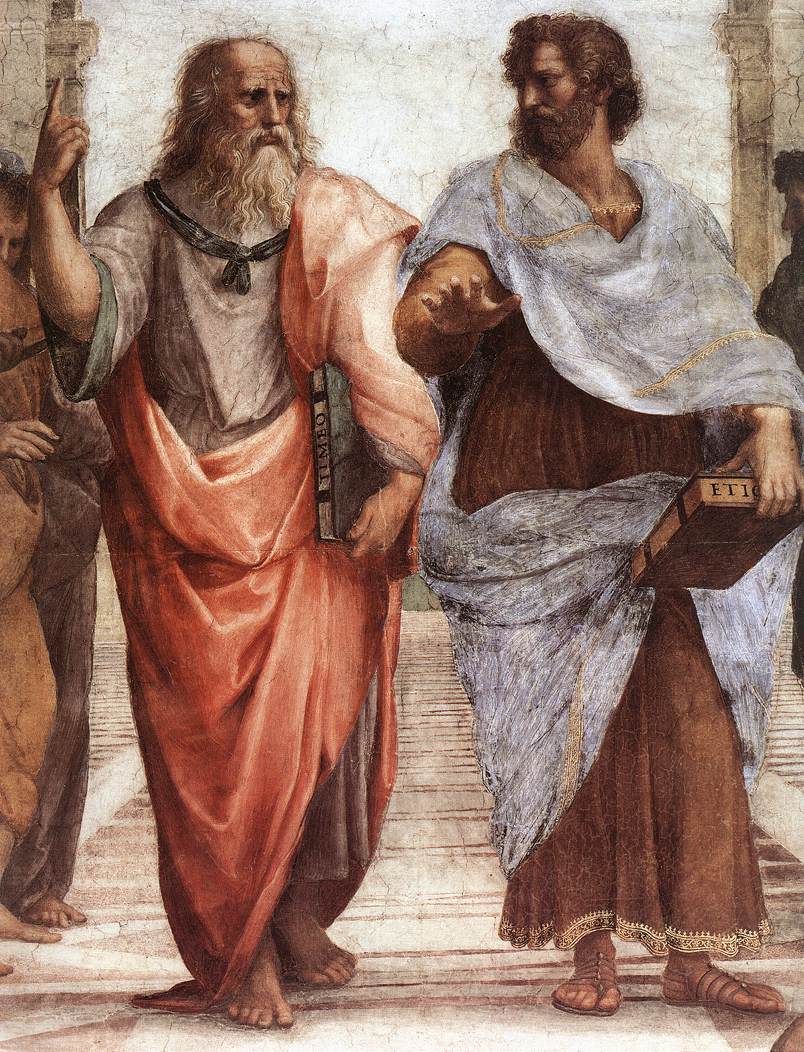
For me this is the most exciting debate to come out of The Speculative Turn, highlighting the differences and marking terrain not just between OOO and "Grantian-Schellingian powers" (for want of a better designation) but at the heart of metaphysics. This question runs right back to Plato and Aristotle: what is primary, substance or power?
Bryant himself pointed out the lineage of this discussion just a few days ago. However, and I think representatives of OOO would agree, it is too simplistic to mark alliances in terms of Aristotle-OOO/Plato-powers. While these alliances are extant, in both cases a process of appropriation, argumentation and transformation is underway. Here, I wish to make two brief points: 1) I disagree with Aristotle'/Levi's reading of Plato; and 2) there is a problem of powers predicated of substances which the productive substances of OOO occlude rather than solve.
First, the Platonic forms are not reified predicates. There is no beauty itself, since new beautiful things are always possible and the complete history of beauty is unrecoverable. The failure of Socrates and his interlocutors to adequately define any of the ideas attests to their non-objectifiable nature. I argue instead for a powers ontology reading of Platonic physics, although this is a point for extended discussion.
Second, the gambit of OOO, that being is plural and substantial, is an attempt to do justice to our experience of mid-size objects and to avoid an ontology of pre-individual apeiron. Plurality is unproblematic, but the substantial element of OOO is tied to a problem of anteriority -the answers to which seem to dissolve the difference between powers and substances.
OOO argues for the creation and destruction of substance and so any necessary ontological substance - a primary substance as uncreated pre-requisite of all being - is ruled out. With productive substances there is a regress of "objects all the way down". I agree with OOO that this is an unproblematic regress, akin to contemporary debates around ungrounded powers.
In powers ontologies their is often an equivocation regarding powers and substances: powers are ungrounded, yet they are also dispositional and predicated of things; i.e. held by something, therefore not ungrounded but grounded in substance. This is the problem of anteriority: if powers are held by substances then from where did the substances come? If substance is a product of powers then either these powers must also be held by substance - and this regress is problematic - or powers are not predicated of substance and are properly ungrounded.
It seems to me that the argument for productive substances of OOO avoids this problem by blurring the definition of substance and power. If "substances are produced out of other substances" and "anteriority is not something other than substances, but rather is composed of other substances" how is substance different from power? The answer to this question is made quite plain by Morton: "production is a substance"; i.e. they're not different except that the production of OOO is 'chunky' or 'lumpy'.
As Bryant observes then, it seems that there is in fact little dispute between ontologies of substance and those of productive powers. But, I feel that this reply leaves too much unexplained. In marking the difference between power and substance we are also returned to another dispute: the relational vs. non-relational. This is a challenge to powers ontologies to which no reply has yet been properly articulated.
Regarding any apeiron of powers, the avoidance of which the lumpy productive of OOO is aimed at, Shaviro puts the point well: "The "pre-individual" (in Simondon, Deleuze, Grant) is NOT continuous, not the whole, not undifferentiated. Rather, it's the realm of powers."
Is there a difference between power and substance? I don't think that they can easily be collapsed and therefore this dispute goes on.
For me this is the most exciting debate to come out of The Speculative Turn, highlighting the differences and marking terrain not just between OOO and "Grantian-Schellingian powers" (for want of a better designation) but at the heart of metaphysics. This question runs right back to Plato and Aristotle: what is primary, substance or power?
Bryant himself pointed out the lineage of this discussion just a few days ago. However, and I think representatives of OOO would agree, it is too simplistic to mark alliances in terms of Aristotle-OOO/Plato-powers. While these alliances are extant, in both cases a process of appropriation, argumentation and transformation is underway. Here, I wish to make two brief points: 1) I disagree with Aristotle'/Levi's reading of Plato; and 2) there is a problem of powers predicated of substances which the productive substances of OOO occlude rather than solve.
First, the Platonic forms are not reified predicates. There is no beauty itself, since new beautiful things are always possible and the complete history of beauty is unrecoverable. The failure of Socrates and his interlocutors to adequately define any of the ideas attests to their non-objectifiable nature. I argue instead for a powers ontology reading of Platonic physics, although this is a point for extended discussion.
Second, the gambit of OOO, that being is plural and substantial, is an attempt to do justice to our experience of mid-size objects and to avoid an ontology of pre-individual apeiron. Plurality is unproblematic, but the substantial element of OOO is tied to a problem of anteriority -the answers to which seem to dissolve the difference between powers and substances.
OOO argues for the creation and destruction of substance and so any necessary ontological substance - a primary substance as uncreated pre-requisite of all being - is ruled out. With productive substances there is a regress of "objects all the way down". I agree with OOO that this is an unproblematic regress, akin to contemporary debates around ungrounded powers.
In powers ontologies their is often an equivocation regarding powers and substances: powers are ungrounded, yet they are also dispositional and predicated of things; i.e. held by something, therefore not ungrounded but grounded in substance. This is the problem of anteriority: if powers are held by substances then from where did the substances come? If substance is a product of powers then either these powers must also be held by substance - and this regress is problematic - or powers are not predicated of substance and are properly ungrounded.
It seems to me that the argument for productive substances of OOO avoids this problem by blurring the definition of substance and power. If "substances are produced out of other substances" and "anteriority is not something other than substances, but rather is composed of other substances" how is substance different from power? The answer to this question is made quite plain by Morton: "production is a substance"; i.e. they're not different except that the production of OOO is 'chunky' or 'lumpy'.
As Bryant observes then, it seems that there is in fact little dispute between ontologies of substance and those of productive powers. But, I feel that this reply leaves too much unexplained. In marking the difference between power and substance we are also returned to another dispute: the relational vs. non-relational. This is a challenge to powers ontologies to which no reply has yet been properly articulated.
Regarding any apeiron of powers, the avoidance of which the lumpy productive of OOO is aimed at, Shaviro puts the point well: "The "pre-individual" (in Simondon, Deleuze, Grant) is NOT continuous, not the whole, not undifferentiated. Rather, it's the realm of powers."
Is there a difference between power and substance? I don't think that they can easily be collapsed and therefore this dispute goes on.

Category:
anteriority,
Aristotle,
Levi Bryant,
plato,
powers,
substance,
The Speculative Turn,
Timothy Morton
The Speculative Turn
Posted by | Chris | 26.12.10 | 1 Comment
 The Speculative Turn, edited by Graham Harman, Levi Bryant and Nick Srnicek, is now available in book form and in a free to download PDF! I was about to read some more Cyclonopedia but I can't wait to read Graham Harman and Iain H Grant fight it out in print.
Introduction
1. Levi Bryant, Nick Srnicek, and Graham Harman, ‘Towards a Speculative Philosophy’
2. Alain Badiou, ‘Interview with Ben Woodard’
Speculative Realism Revisited
3. Graham Harman, ‘On the Undermining of Objects: Grant, Bruno and Radical Philosophy’
4. Iain Hamilton Grant, ‘Mining Conditions: A Response to Harman’
5. Ray Brassier, ‘Concepts and Objects’
6. Iain Hamilton Grant, ‘Does Nature Stay What-it-is? Dynamics and the Antecendence Criterion’
7. Alberto Toscano, ‘Against Speculation, or, A Critique of the Critique of Critique’
After Finitude
8. Adrian Johnston, ‘Hume’s Revenge: À Dieu, Meillassoux?’
9. Martin Hägglund, ‘Radical Atheist Materialism: A Critique of Meillassoux’
10. Peter Hallward, ‘Anything is Possible: A Reading of Quentin Meillassoux’s After Finitude’
11. Nathan Brown, ‘The Speculative and the Specific: On Hallward and Meillassoux’
Politics
12. Nick Srnicek, ‘Capitalism and the Non-Philosophical Subject’
13. Reza Negarestani, ‘Drafting the Inhuman: Conjectures on Capitalism and Organic Necrocracy’
14. Slavoj Žižek, ‘Is it Still Possible to be a Hegelian Today?’
Metaphysics
15. Quentin Meillassoux, ‘Potentiality and Virtuality’
16. François Laruelle, ‘The Generic as Predicate and Constant: Non-Philosophy and Materialism’
17. Levi Bryant, ‘The Ontic Principle: Outline of an Object-Oriented Ontology’
18. Steven Shaviro, ‘The Actual Volcano: Whitehead, Harman and the Problem of Relations’
19. Graham Harman, ‘Response to Shaviro’
20. Bruno Latour, ‘Reflections on Etienne Souriau’s Les différents modes d’existence’
21. Gabriel Catren, ‘Outland Empire’
Science
22. Isabelle Stengers, ‘Wondering about Materialism’
23. Manuel DeLanda, ‘Emergence, Causality, and Realism’
24. John Protevi, ‘Ontology, Biology, and History of Affect’
Conclusion
25. Slavoj Žižek, ‘Interview with Ben Woodard’
What Kind of Emergence?
Posted by | Chris | 13.9.10 | No Comments

A couple of things that I have read recently have given articulation to some things I've been thinking which I hope clarify our panpsychist project. Reading Iain's talk from the Speculative Realism section of Collapse III put into perspective questions of the relation of a transcendental method and a speculative project in panpsychism. I have said before that if we begin from a realism about experience or thought then a question motivating further inquiry is: "Given that there is thought what must the world be like that thought is a part of the world?" This comes close to a transcendental question: "What are the necessary requirements that thought is possible?"
The argument made by Iain is that the two do indeed share something: an interest in the necessary, although not sufficient, conditions for thought. Conditions are necessary in that thought in general would not exist without these conditions but they are not sufficient to determine specific thoughts. For Kant this means that no thought is determined but Iain draws this further out, and this is where he diverges from Kant. Kant's transcendental is legislated by thought, thought grounding thought, and so in this domain it is absolutely certain. But this is impossible for any realism because thought must be the product of something anterior. For Iain this is nature, and so the varieties of thought or forms of thinking are not determined either. Being produces thinking but "we simply have to give up the illusion that the domain of thinking we call reflection is coextensive with thinking tout court" (Collapse V.III, p. 350).
I've also been following the DeLanda reading group and a post by Levi Bryant really opened something up for me. DeLanda's theory of assemblages is opposed to organic totalities (such as Hegel's) and this is because every part of any system is an entity with structure or power beyond it's relations to the system as a whole. The relations in a system are external to the entities assembled in it and: "The central feature of relations of exteriority is that the components of an assemblage may be detached from it and plugged into a different assemblage in which it's interactions are different".
In Bryant's case this exposition of DeLanda is obviously in the context of an Object Oriented Ontology. But DeLanda being a Deleuzian you could easily make the same kinds of arguments in a powers/process/idealist ontology. The properties of some entity do not exhaust its being because in a different context it may manifest differently characteristics. This seems especially interesting in relation to panpsychism since the potential for psyche to be manifest may not always be given in an environment. But where conditions are met the psyche which was always a power in reserve may bloom forth.
This still doesn't get us past the idealism/dualism dichotomy but I think it's important to recognise that causality, whether of a pre-individual Ideation or of heterogeneous powers, is a problem which requires work beyond our project. Within the scope of our project we want only to make an argument that panpsychism be taken seriously. I think that we probably have a number of resources to make such an argument.
rss:


 Posts
All Comments
Posts
All Comments