
Thirst for Annihilation
Posted by | Chris | 4.4.11 | 1 Comment
Particles decay, molecules disintegrate, cells die, organisms perish, species become extinct, planets are destroyed and stars burn-out, galaxies explode…until the unfathomable thirst of the entire universe collapses into darkness and ruin. Death, glorious and harsh, sprawls vast beyond all suns, sheltered by the sharp flickerlip of flame and silence, cold mother of all gods, hers is the deep surrender. If we are to resent nothing—not even nothing—it is necessary that all resistance to death cease. We are made sick by our avidity to survive, and in our sickness is the thread that leads back and nowhere, because we belong to the end of the universe. The convulsion of dying stars is our syphilitic inheritance. (146)In Mark Fisher's talk at the Accelerationism conference last year he says that Nick Land “took seriously to the level of psychosis and auto-induced schizophrenia – and that's really true – the Spinozist-Nietzaschean-Marxist injunction that a theory cannot be serious if it remains at the level of representation”. Thirst for Annihilation: George Bataille and Virulent Nihilism is not then a work of academic study but a practise, or an attempt at one, a working with Bataille in an exacerbation aimed at collapse of the strictures of the academy, religion, philosophy and ultimately humanity.
Land's work with Bataille is something like an experimental physics of expenditure. Bataille's solar economy ungrounds thought by recognising all power as given antecedently by a greater power. This economy is not one of increasing returns or teleological aims however, but a meaningless waste of energy, consistent and purposeless expenditure. Living creatures and all societies are marginal detours in a return to nothing, or death.
Death is perhaps the central concept of the book and I find it difficult to fully articulate all of the ways in which Land deploys it. For one thing at least, death is not the phenomenological horizon of anything's being, nor is it simply the entropic slide to disorganisation. Death is the negative force at the heart of Land's ontology, the aggressive exchange of power to the sum of zero.
Among the motors of Land's book is his septic hatred for all hierarchy, all territorialism. Land's sworn enemy is God, the emblem of all conservative authoritarian accumulation. Land argues quite interestingly for atheism understood in a positive sense; it indexes not a reaction against-God, but a productive real without God. What sometimes undermines this argument, and occasionally tried my patience, is Land's obsessive return to the subject of theism, seemingly incapable of getting more than a few paragraphs without hurling some new insult. This insistent hatred doesn't only weaken arguments about atheism however, but points to a larger problem within the book as a whole.
After God, Land's most despised enemy is Kant, and the sections dealing with his legacy are among the most interesting of the book. Land's position as a founding influence among speculative realism is clear from many passages and his diagnosis of the withered and introverted state of post-Kantian philosophy exhilarating to behold, accomplished as it is with the nauseating gusto of Land's writing.
Land's remedy to Kant's division of the world according to epistemology is an ontology of primary production from which thought as secondary production arises. Base materialism as put forward by Bataille considers all matter as libidinally powered and productive. Base matter produces thought and instantiates a second order of production with a tendency to transcendentalise itself, to take credit for all action in the world and demote base matter to inert resistance. A libidinal materialism however recognises the power of base matter and is able to make contact with in certain intensifying actions: sex, violence, visceral and bodily connections unmediated by thought.
Land's Bataillean subversion of the Kantian schema owes much to Deleuze and Nietzsche with intensive powers providing the motor for non-teleological becoming. The problem that I see in Land's project owes to an imbalance or one-sidedness of concept. What does death destroy, what does action intensify, if not the conservative forces of instituted order? But what institutes order?
It seems to me that Land is obsessed with God because he needs Him; without a territorialising force there would be nothing to deterritorialise. Of organising creativity Land has almost nothing to say, except for a brief section on negentropy where diversion from expenditure is ruled “not impossible”. Chance deviation is basis of all instituted structure yet this seems exceptionally poorly matched to the all consuming power of death, or zero, as the eternal motor of destructive exchange. A political or theological dualism between massive ordered hierarchy and atomised co-operative anarchy is ontologised with the greater share of power going to all deterritorialising forces, leaving accumulative forces under-explained except for the dictatorial myth of God and society.
Despite it's flaws and it's occasionally self-indulgent prose Land's book is an exceptional work, and exhilarating ride through an axis of philosophy rarely explored with such bilious fury. At it's highlights, especially those sections where Land undermines Kant with dark sarcasm and a carefully chosen quote from one of the critiques, it's philosophy at it's most exciting. Like Nietzscheanism it's difficult to imagine anyone living like this, and Land it seems wasn't able to keep up the relentless pace, but as inspiration for all deviant intellectuals it is unparalleled.

The differentiated powers of lumpy productive substance
Posted by | Chris | 22.2.11 | 1 Comment
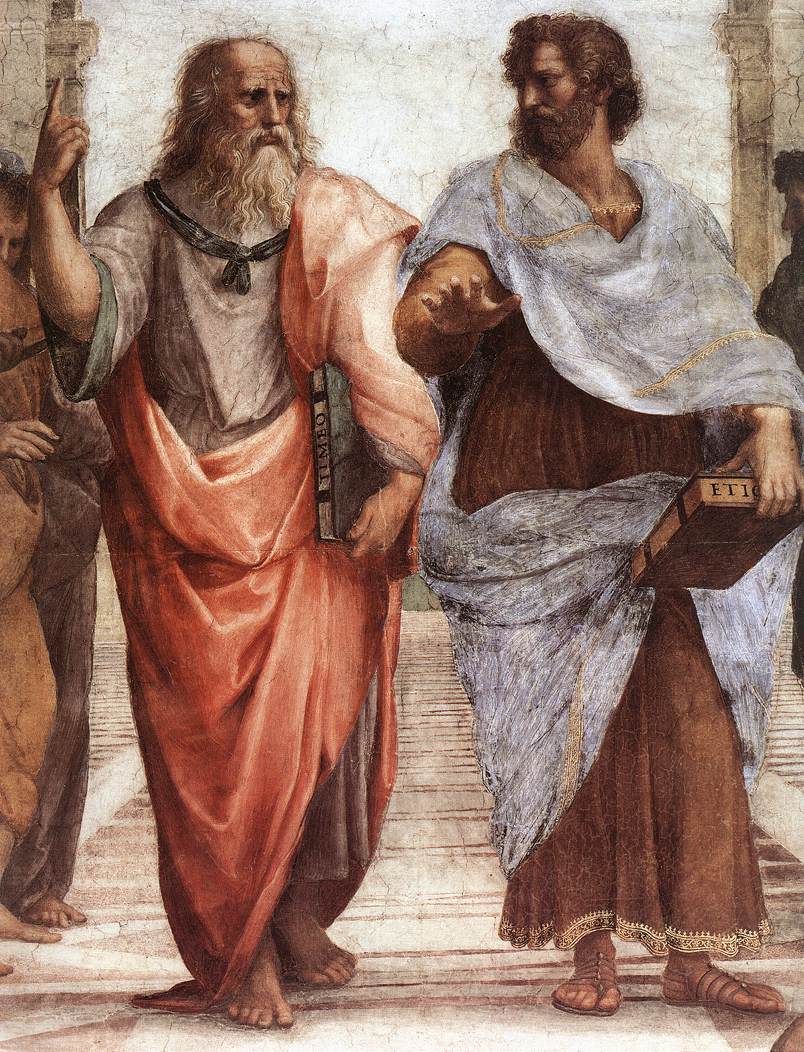
In a continuing series of comments regarding comments about replies to replies Levi Bryant talks about anteriority and references a twitter discussion here and here.
For me this is the most exciting debate to come out of The Speculative Turn, highlighting the differences and marking terrain not just between OOO and "Grantian-Schellingian powers" (for want of a better designation) but at the heart of metaphysics. This question runs right back to Plato and Aristotle: what is primary, substance or power?
Bryant himself pointed out the lineage of this discussion just a few days ago. However, and I think representatives of OOO would agree, it is too simplistic to mark alliances in terms of Aristotle-OOO/Plato-powers. While these alliances are extant, in both cases a process of appropriation, argumentation and transformation is underway. Here, I wish to make two brief points: 1) I disagree with Aristotle'/Levi's reading of Plato; and 2) there is a problem of powers predicated of substances which the productive substances of OOO occlude rather than solve.
First, the Platonic forms are not reified predicates. There is no beauty itself, since new beautiful things are always possible and the complete history of beauty is unrecoverable. The failure of Socrates and his interlocutors to adequately define any of the ideas attests to their non-objectifiable nature. I argue instead for a powers ontology reading of Platonic physics, although this is a point for extended discussion.
Second, the gambit of OOO, that being is plural and substantial, is an attempt to do justice to our experience of mid-size objects and to avoid an ontology of pre-individual apeiron. Plurality is unproblematic, but the substantial element of OOO is tied to a problem of anteriority -the answers to which seem to dissolve the difference between powers and substances.
OOO argues for the creation and destruction of substance and so any necessary ontological substance - a primary substance as uncreated pre-requisite of all being - is ruled out. With productive substances there is a regress of "objects all the way down". I agree with OOO that this is an unproblematic regress, akin to contemporary debates around ungrounded powers.
In powers ontologies their is often an equivocation regarding powers and substances: powers are ungrounded, yet they are also dispositional and predicated of things; i.e. held by something, therefore not ungrounded but grounded in substance. This is the problem of anteriority: if powers are held by substances then from where did the substances come? If substance is a product of powers then either these powers must also be held by substance - and this regress is problematic - or powers are not predicated of substance and are properly ungrounded.
It seems to me that the argument for productive substances of OOO avoids this problem by blurring the definition of substance and power. If "substances are produced out of other substances" and "anteriority is not something other than substances, but rather is composed of other substances" how is substance different from power? The answer to this question is made quite plain by Morton: "production is a substance"; i.e. they're not different except that the production of OOO is 'chunky' or 'lumpy'.
As Bryant observes then, it seems that there is in fact little dispute between ontologies of substance and those of productive powers. But, I feel that this reply leaves too much unexplained. In marking the difference between power and substance we are also returned to another dispute: the relational vs. non-relational. This is a challenge to powers ontologies to which no reply has yet been properly articulated.
Regarding any apeiron of powers, the avoidance of which the lumpy productive of OOO is aimed at, Shaviro puts the point well: "The "pre-individual" (in Simondon, Deleuze, Grant) is NOT continuous, not the whole, not undifferentiated. Rather, it's the realm of powers."
Is there a difference between power and substance? I don't think that they can easily be collapsed and therefore this dispute goes on.
For me this is the most exciting debate to come out of The Speculative Turn, highlighting the differences and marking terrain not just between OOO and "Grantian-Schellingian powers" (for want of a better designation) but at the heart of metaphysics. This question runs right back to Plato and Aristotle: what is primary, substance or power?
Bryant himself pointed out the lineage of this discussion just a few days ago. However, and I think representatives of OOO would agree, it is too simplistic to mark alliances in terms of Aristotle-OOO/Plato-powers. While these alliances are extant, in both cases a process of appropriation, argumentation and transformation is underway. Here, I wish to make two brief points: 1) I disagree with Aristotle'/Levi's reading of Plato; and 2) there is a problem of powers predicated of substances which the productive substances of OOO occlude rather than solve.
First, the Platonic forms are not reified predicates. There is no beauty itself, since new beautiful things are always possible and the complete history of beauty is unrecoverable. The failure of Socrates and his interlocutors to adequately define any of the ideas attests to their non-objectifiable nature. I argue instead for a powers ontology reading of Platonic physics, although this is a point for extended discussion.
Second, the gambit of OOO, that being is plural and substantial, is an attempt to do justice to our experience of mid-size objects and to avoid an ontology of pre-individual apeiron. Plurality is unproblematic, but the substantial element of OOO is tied to a problem of anteriority -the answers to which seem to dissolve the difference between powers and substances.
OOO argues for the creation and destruction of substance and so any necessary ontological substance - a primary substance as uncreated pre-requisite of all being - is ruled out. With productive substances there is a regress of "objects all the way down". I agree with OOO that this is an unproblematic regress, akin to contemporary debates around ungrounded powers.
In powers ontologies their is often an equivocation regarding powers and substances: powers are ungrounded, yet they are also dispositional and predicated of things; i.e. held by something, therefore not ungrounded but grounded in substance. This is the problem of anteriority: if powers are held by substances then from where did the substances come? If substance is a product of powers then either these powers must also be held by substance - and this regress is problematic - or powers are not predicated of substance and are properly ungrounded.
It seems to me that the argument for productive substances of OOO avoids this problem by blurring the definition of substance and power. If "substances are produced out of other substances" and "anteriority is not something other than substances, but rather is composed of other substances" how is substance different from power? The answer to this question is made quite plain by Morton: "production is a substance"; i.e. they're not different except that the production of OOO is 'chunky' or 'lumpy'.
As Bryant observes then, it seems that there is in fact little dispute between ontologies of substance and those of productive powers. But, I feel that this reply leaves too much unexplained. In marking the difference between power and substance we are also returned to another dispute: the relational vs. non-relational. This is a challenge to powers ontologies to which no reply has yet been properly articulated.
Regarding any apeiron of powers, the avoidance of which the lumpy productive of OOO is aimed at, Shaviro puts the point well: "The "pre-individual" (in Simondon, Deleuze, Grant) is NOT continuous, not the whole, not undifferentiated. Rather, it's the realm of powers."
Is there a difference between power and substance? I don't think that they can easily be collapsed and therefore this dispute goes on.
Category:
anteriority,
Aristotle,
Levi Bryant,
plato,
powers,
substance,
The Speculative Turn,
Timothy Morton
The Future Is...
Posted by | Chris | 29.12.10 | 4 Comments
Steven Shaviro's chapter in The Speculative Turn (“The Actual Volcano: Whitehead, Harman, and the Problem of Relations”) continues an ongoing argument aimed at the Object Oriented Ontologists. For Harman and OOO objects are withdrawn from all relations in their ultimate being. No relation or set of relations can ever exhaust an object since it is a substance above and beyond all of its encounters with other objects. In contrast there is a large, and sometimes disparate, group of philosophers who maintain that the ontological being of things inheres in their relations. Alfred North Whitehead is unquestionably one of these and is championed by Shaviro as holding the answers to a great many metaphysical problems.
I've got a great deal of respect for Shaviro's Whiteheadianism; Whitehead is perhaps my favourite philosopher and Shaviro's work has done a great deal to present and make clear the relevancy of Whitehead to contemporary debates. I love Shaviro's application of Whitehead to contemporary technological and cultural questions too. However, in the current debate I find I'm more keenly aware of Whitehead's shortcomings than of his sometimes daring, but always urbane, contributions to philosophy.
Graham Harman has often made clear his debt and appreciation to Whitehead, but equally he has been quick to point out the difficulties presented by Whitehead's ontology. Primary amongst these is Whitehead's relationism. For Harman any ontology defined entirely by its relations is unable to account for change. If any entity is defined by it's relations then it is exhaustively defined, there is nothing beyond its relations and hence nothing which might act as a motor for change in the entity.
I find it interesting that while Whitehead's realtionism is the main point of argument in Harman's reply, he makes no mention of 'decision' which holds a central place in Shaviro's Whiteheadian rebuttals to OOO. In Whitehead's philosophy decision is the final act whereby entities become what they are. It is the selection among alternatives which gives each entity its particular view on the world. Recently Shaviro has suggested that some variant of panpsychism might more usefully address problems in the sciences (as opposed to a focus on 'life') by considering mentality incipient in all things. This mentality Shaviro construes in terms of decision.
Perhaps the reason Harman does not address decision is that a criticism of it is implicit in his attack on Whitehead's relationism:
I fear that Harman may be right about this. There are further problems for Shaviro and Whitehead when one considers God's role in every actual entity's decision (the freedom of which is extremely questionable). And yet I'm not willing to concede an absolute victory to Harman in this case. Whitehead's metaphysics may not be riddled with difficulties (or possibly incoherent), but there is more in it than Harman's argument implies.
For one, I reject Whitehead's ontological principle as the measure of his metaphysics. This is contrary to Whitehead's explicit intentions, but it seems to me that Whitehead himself fails to maintain the principle. If the reason for any change is to be found in actual entities then the notion of an actual entity must be expanded to include the eternal objects. This brings me to my second objection: I strongly disagree with Harman's characterisation of 'eternal objects'.
In Adventures of Ideas Whitehead explicates his metaphysics as a doctrine of immanent law by way of Plato's definition of being as power:
To pull Whitehead in this direction is to make him something like a philosopher of the rumbling apeiron of thinkers like Grant (see below) and Harman is clear that he rejects interpreting Whitehead in this way:
Having come this far from Whitehead's original intention however, it has to be asked if we're strictly Whiteheadians any more. Nor would any of this answer Harman's criticisms of Relationism. But I continue to find The Speculative Turn an exhilarating read suggestive of so many possibilities. I wish Shaviro all the best and I'm totally intrigued by OOO; I'm really excited to see where it goes.
I've got a great deal of respect for Shaviro's Whiteheadianism; Whitehead is perhaps my favourite philosopher and Shaviro's work has done a great deal to present and make clear the relevancy of Whitehead to contemporary debates. I love Shaviro's application of Whitehead to contemporary technological and cultural questions too. However, in the current debate I find I'm more keenly aware of Whitehead's shortcomings than of his sometimes daring, but always urbane, contributions to philosophy.
Graham Harman has often made clear his debt and appreciation to Whitehead, but equally he has been quick to point out the difficulties presented by Whitehead's ontology. Primary amongst these is Whitehead's relationism. For Harman any ontology defined entirely by its relations is unable to account for change. If any entity is defined by it's relations then it is exhaustively defined, there is nothing beyond its relations and hence nothing which might act as a motor for change in the entity.
I find it interesting that while Whitehead's realtionism is the main point of argument in Harman's reply, he makes no mention of 'decision' which holds a central place in Shaviro's Whiteheadian rebuttals to OOO. In Whitehead's philosophy decision is the final act whereby entities become what they are. It is the selection among alternatives which gives each entity its particular view on the world. Recently Shaviro has suggested that some variant of panpsychism might more usefully address problems in the sciences (as opposed to a focus on 'life') by considering mentality incipient in all things. This mentality Shaviro construes in terms of decision.
Perhaps the reason Harman does not address decision is that a criticism of it is implicit in his attack on Whitehead's relationism:
As [Whitehead] puts it early in Process and Reality: ‘The analysis of an actual entity into “prehensions” is that mode of analysis which exhibits the most concrete elements in the nature of actual entities’. In other words, to speak of actual entities in terms of anything but their prehensions is a mere abstraction; the entities themselves are concrescences, or systems of prehensions.(Response to Shaviro: 296).The entities of Whitehead's ontology are nothing but their relations and there is not substance or power left over which could make any decision.
I fear that Harman may be right about this. There are further problems for Shaviro and Whitehead when one considers God's role in every actual entity's decision (the freedom of which is extremely questionable). And yet I'm not willing to concede an absolute victory to Harman in this case. Whitehead's metaphysics may not be riddled with difficulties (or possibly incoherent), but there is more in it than Harman's argument implies.
For one, I reject Whitehead's ontological principle as the measure of his metaphysics. This is contrary to Whitehead's explicit intentions, but it seems to me that Whitehead himself fails to maintain the principle. If the reason for any change is to be found in actual entities then the notion of an actual entity must be expanded to include the eternal objects. This brings me to my second objection: I strongly disagree with Harman's characterisation of 'eternal objects'.
[Whitehead] thinks that qualities pre-exist: he calls them ‘eternal’, after all, and links them with the Platonic forms. No new qualities can ever be produced for Whitehead, for all his reputation as a philosopher of novelty: what is produced in his view is simply new constellations of actual entities, prehended according to pre-existing eternal objects (Ibid: 298).Whitehead certainly deserves some of the blame for this - I wish he'd called his potentials anything but 'eternal' - but Harman's linking them to Platonic forms (in a pejorative sense) needs some explanation. There's little question that Whitehead is a Platonist, but to suggest that his metaphysics conforms to two-worlds ontology of forms is to do a disservice both thinkers.
In Adventures of Ideas Whitehead explicates his metaphysics as a doctrine of immanent law by way of Plato's definition of being as power:
My suggestion would be, that anything which possesses any sort of power to affect another, or to be affected by another even for a moment, however trifling the cause and however slight and momentary the effect, has real existence; and that the definition of being is simply power (Plato, Sophist, 247E).A powers ontology is a long way from the traditional two-worlds ontology traditionally attributed to Plato. To similarly complicate Whitehead's ontology, would be to include eternal objects in the creative generation of the actual entities in the manner promised by Whitehead if not delivered.
To pull Whitehead in this direction is to make him something like a philosopher of the rumbling apeiron of thinkers like Grant (see below) and Harman is clear that he rejects interpreting Whitehead in this way:
You can say what you like about Whitehead […] being interested in process and history. But the real point for them is that all such process is produced by the work of individual entities—a claim that would merely be nonsense for Deleuze, Bergson, Simondon, DeLanda, and Grant (Response to Shaviro: 294).Pushing Whitehead to his limits however, I have often wondered how far he extends his claim to the contingency of the laws of nature? Is the process of actual occasions also contingent? What power determines them? Might it be argued that actual entities are themselves the products of powers and therefore not the "individual entities" doing the work?
Having come this far from Whitehead's original intention however, it has to be asked if we're strictly Whiteheadians any more. Nor would any of this answer Harman's criticisms of Relationism. But I continue to find The Speculative Turn an exhilarating read suggestive of so many possibilities. I wish Shaviro all the best and I'm totally intrigued by OOO; I'm really excited to see where it goes.
Category:
graham harman,
iain grant,
OOO,
powers,
relationism,
Steven Shaviro,
The Speculative Turn,
whitehead
Reasons?
Posted by | Chris | 18.7.10 | 1 Comment

One of the things that really struck me from ‘All Things Think’ was the use of the word “reason” in two senses. In the context of a discussion of the principle of sufficient reason (page 297 from which every quote below is taken unless otherwise stated), reason is both rational and grounding cause. I’m intrigued to understand more of this since my feeling is that the chapter spends some time dealing with the “pan-” of panpsychism but much less on the “psyche”; what is the power of psyche that is genetically related to being?
“We may now move on to the genetic or causal claim on the part of externalism”; the first step in this is to move beyond empirical philosophy to embrace a realism concerning causes in nature. Hume has shown that empirical in experimental philosophy causality can only be grounded in “anthroponoetic habit”, which is not grounded at all. Alternative to empirical philosophy then a realist metaphysics must ground causality in something else. Iain argues that Leibniz provides a principle potentially able to do just this.
I’ve read very little Leibniz and have only vague feelings about the kind of work he produced. Looking things up for this post I read interpretation of the principle of sufficient reason (PoSR from now on) as an argument for determinism. The first example given by Iain is from the Monadology: “there can be no fact can real or existing, no statement true, unless there be a sufficient reason why it should be so and not otherwise” (my emphasis). This certainly seems to imply determinism. However, it is not determinism which we are concerned with (not at the moment anyway) but reason and existence and the relationship between them.
Another statement of the PoSR comes in the Theodicy: “nothing ever comes to pass without there being a cause or at least a reason determining it, that is, something to give an a priori reason why it is existent rather than non-existent, and in this wise rather than in any other”. This is halfway to the other formulation given in the chapter (from the Principles of Nature and Grace Based on Reason): “the full cause is equivalent to the entire effect”. That the Theodicy links cause and reason gives some weight to the argument for “equivalence relations between reason and existence and cause and effect”. This argument in the chapter is conditional on the statements from the Monadology and Principles of Nature and Grace being one and not two different principles, a condition for which little argument is made. The formulation of the Theodicy supports the reading of the PoSR as principle of reason and causality. If we accept then that reason and cause are equivalent it is argued that “the reason for existence is a causal one and […] existence is always the effect of a reason”.
The externality thesis taken from Bosanquet coupled with the dynamic interpretation of Parmenides’ identity thesis is suggested as satisfying reason in the equivalent way of the PoSR. I do not fully understand externality but as I read it externality refers to the temporal dimension of nature, the activity (which is genetic) of priors in posteriors (which are complementary) or the metaphysical process of becoming; it is about time, activity and causality then. Causality in this sense is productive and equivalency is then understood generatively: “being = thinking entails that being generates thinking; in naturalistic terms, nature = reason entails that nature generates reasoning” (emphasis in the original).
Three conclusions are drawn from the argument so far:
All this, so far, I think I understand. But I still don’t now what kind of power “thinking” or “reasoning” are. Obviously I experience my own thoughts or reasons but this does not seems the same as a simple cause, the kind active in every event in nature. Two lines of thought may expand this for us. First, the equivalence/generativity of reasons and causes to existents and effects is asymmetric in that “there is more in reason than in existence […] and more causes than have actual effects”. As I mentioned in a previous post I argue that a realist metaphysics will make reference to forms or powers that exceed their particular instantiation. This is a metaphysics in line with Plato (dynamically, not dualistically, understood), an ontology of universal and particular, virtual and real, eternal entity and actual occasion. Whichever way you choose to describe it reality is wider, or deeper, than actuality. In this sense then reason is a power of this depth.
Pierre Hadot’s The Veil of Isis is a history of the idea of nature from Heraclitus aphorism “nature loves to hide (phusis kruptesthai philein)”. These words have been variously understood: that all that lives tends to die; that nature is hard to know; that it wraps itself in sensible forms and myths; that it hides occult virtues within it, and that nature folds and unfolds forms from and infinite or ineffable Being. It is related to this final sense that towards the end of the book Hadot quotes Nietzsche from The Gay Science: “We should have more respect for the modesty with which Nature hides behind enigmas and colourful uncertainties. Perhaps Truth is a women who has reasons for not wanting to let her reasons be seen” (preface §4). The word translated as “reason” is “gründe” in the German. Reason is grounded in reason and these reasons (grounds) extend all the way down. No final reason can be given, for this would deprive reason of its power, and power is ungrounded. This is the second potential line of thought, that reason is the grounding of power and it is from this ground that posterior reasons are generatively powerful.
My etymological dictionary defines “reason” as a “fact or circumstance serving as ground or motive for action; intellectual power, thinking faculty”. Reason in the first sense is gründe; in the second sense raison (Leibniz wrote in French). The generative process of being and the dynamic movement from being to thinking is a serial repetition. Might we talk of this process under a new word (and yet another philosophical language): psyche (psūkhé)? The original meaning of breath, the breath that animates life, has a dipolar character something like a systole and diastole or a contraction and expansion. The contraction of being in actuality is then a formative ground for expansion into reason and contraction to new grounds.
I think it’s time to stop now since, first, I have collapsed the externality which described the dynamic panpsychism argued for, and second, I’m writing bad poetry and quoting from a dictionary. I still have these questions then: what power is reason and where’s the psyche?
“We may now move on to the genetic or causal claim on the part of externalism”; the first step in this is to move beyond empirical philosophy to embrace a realism concerning causes in nature. Hume has shown that empirical in experimental philosophy causality can only be grounded in “anthroponoetic habit”, which is not grounded at all. Alternative to empirical philosophy then a realist metaphysics must ground causality in something else. Iain argues that Leibniz provides a principle potentially able to do just this.
I’ve read very little Leibniz and have only vague feelings about the kind of work he produced. Looking things up for this post I read interpretation of the principle of sufficient reason (PoSR from now on) as an argument for determinism. The first example given by Iain is from the Monadology: “there can be no fact can real or existing, no statement true, unless there be a sufficient reason why it should be so and not otherwise” (my emphasis). This certainly seems to imply determinism. However, it is not determinism which we are concerned with (not at the moment anyway) but reason and existence and the relationship between them.
Another statement of the PoSR comes in the Theodicy: “nothing ever comes to pass without there being a cause or at least a reason determining it, that is, something to give an a priori reason why it is existent rather than non-existent, and in this wise rather than in any other”. This is halfway to the other formulation given in the chapter (from the Principles of Nature and Grace Based on Reason): “the full cause is equivalent to the entire effect”. That the Theodicy links cause and reason gives some weight to the argument for “equivalence relations between reason and existence and cause and effect”. This argument in the chapter is conditional on the statements from the Monadology and Principles of Nature and Grace being one and not two different principles, a condition for which little argument is made. The formulation of the Theodicy supports the reading of the PoSR as principle of reason and causality. If we accept then that reason and cause are equivalent it is argued that “the reason for existence is a causal one and […] existence is always the effect of a reason”.
The externality thesis taken from Bosanquet coupled with the dynamic interpretation of Parmenides’ identity thesis is suggested as satisfying reason in the equivalent way of the PoSR. I do not fully understand externality but as I read it externality refers to the temporal dimension of nature, the activity (which is genetic) of priors in posteriors (which are complementary) or the metaphysical process of becoming; it is about time, activity and causality then. Causality in this sense is productive and equivalency is then understood generatively: “being = thinking entails that being generates thinking; in naturalistic terms, nature = reason entails that nature generates reasoning” (emphasis in the original).
Three conclusions are drawn from the argument so far:
- “[N]ature thinks, or reasoning is one of the powers causally operative in nature”.
- “[T]hinking is finite with respect to the that generates it”
- Consciousness is the product of reason which is the product of nature. Consciousness is not self creating but is generated by and forms a part of nature.
All this, so far, I think I understand. But I still don’t now what kind of power “thinking” or “reasoning” are. Obviously I experience my own thoughts or reasons but this does not seems the same as a simple cause, the kind active in every event in nature. Two lines of thought may expand this for us. First, the equivalence/generativity of reasons and causes to existents and effects is asymmetric in that “there is more in reason than in existence […] and more causes than have actual effects”. As I mentioned in a previous post I argue that a realist metaphysics will make reference to forms or powers that exceed their particular instantiation. This is a metaphysics in line with Plato (dynamically, not dualistically, understood), an ontology of universal and particular, virtual and real, eternal entity and actual occasion. Whichever way you choose to describe it reality is wider, or deeper, than actuality. In this sense then reason is a power of this depth.
Pierre Hadot’s The Veil of Isis is a history of the idea of nature from Heraclitus aphorism “nature loves to hide (phusis kruptesthai philein)”. These words have been variously understood: that all that lives tends to die; that nature is hard to know; that it wraps itself in sensible forms and myths; that it hides occult virtues within it, and that nature folds and unfolds forms from and infinite or ineffable Being. It is related to this final sense that towards the end of the book Hadot quotes Nietzsche from The Gay Science: “We should have more respect for the modesty with which Nature hides behind enigmas and colourful uncertainties. Perhaps Truth is a women who has reasons for not wanting to let her reasons be seen” (preface §4). The word translated as “reason” is “gründe” in the German. Reason is grounded in reason and these reasons (grounds) extend all the way down. No final reason can be given, for this would deprive reason of its power, and power is ungrounded. This is the second potential line of thought, that reason is the grounding of power and it is from this ground that posterior reasons are generatively powerful.
My etymological dictionary defines “reason” as a “fact or circumstance serving as ground or motive for action; intellectual power, thinking faculty”. Reason in the first sense is gründe; in the second sense raison (Leibniz wrote in French). The generative process of being and the dynamic movement from being to thinking is a serial repetition. Might we talk of this process under a new word (and yet another philosophical language): psyche (psūkhé)? The original meaning of breath, the breath that animates life, has a dipolar character something like a systole and diastole or a contraction and expansion. The contraction of being in actuality is then a formative ground for expansion into reason and contraction to new grounds.
I think it’s time to stop now since, first, I have collapsed the externality which described the dynamic panpsychism argued for, and second, I’m writing bad poetry and quoting from a dictionary. I still have these questions then: what power is reason and where’s the psyche?
Category:
Chris,
iain grant,
Leibniz,
panpsychism,
powers,
principle of sufficient reason,
ungrounded
rss:


 Posts
All Comments
Posts
All Comments